
Production Safety: Why Sandboxing, Trust, and Reset Are Non-Negotiable
Why sandboxing, trust ladders, reset controls, and tripwires are mandatory before self-rewriting code touches production.
Tag chips now link to a real page instead of sitting as dead text.
Why sandboxing, trust ladders, reset controls, and tripwires are mandatory before self-rewriting code touches production.
Why best-of-N search outperforms one-shot mutation proposals when the search space is wide and the judge is stable.
Why a fixed judge needs a separate challenger that makes the data harder without moving the goalposts.
Why durable artifacts, row-level traces, and operator-facing dashboards turn mutation loops into auditable systems.
Why the orchestrator must read evidence, request one bounded mutation, verify it, and revert failure cleanly.
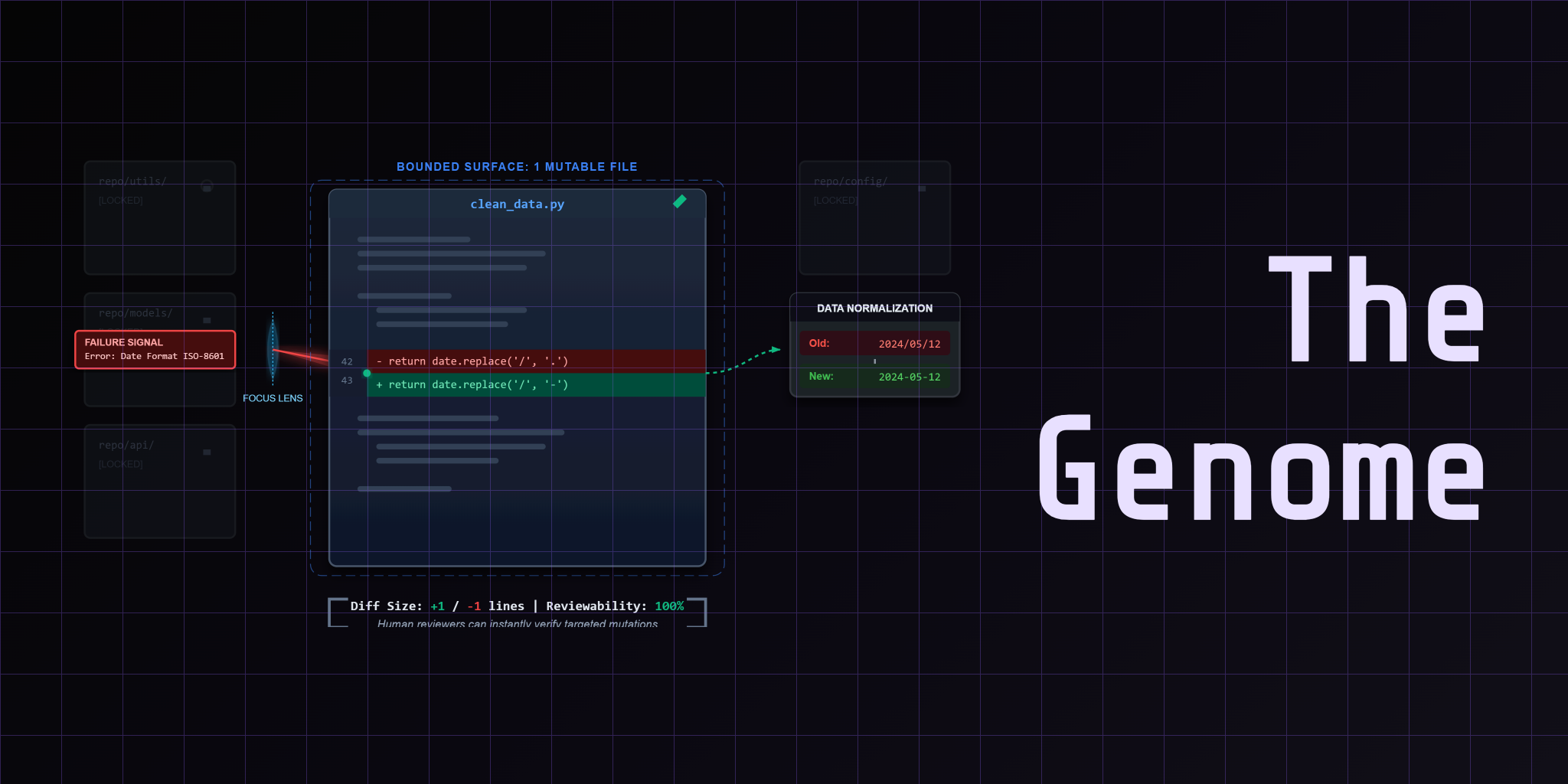
Why self-improving systems need one mutable genome, one fixed judge, and clean rollback boundaries.
Why bounded mutation contracts matter before the first AI-generated repair attempt touches your pipeline.
A repo-first walkthrough of CleanLoop, the bounded mutation loop that repairs finance pipelines with one mutable genome and one fixed judge.
A seven-part map of the CleanLoop architecture, from bounded mutation and genome design to observability, reranking, and production safety.